Tuesday, July 14, 2020

Game of Thrones Was A Documentary

“Game of Thrones Revisited”

Remember all the disappointed hullabaloo over Game of Thrones’ last few seasons and its ending? It struck me at the time that it was somewhat clueless, as the show couldn’t have ended much better – if you were a sort of democrat.  If you were a conventional royalist, then your disappointment would be great.  If you were unaware of the past or modern historical references buried in the story, then you would be flummoxed.

The night fog of war
Like others in this time of COVID, I’ve re-watched the whole series, which I think will rate as one of the great modern myths.  Unlike Joseph Campbell who looked back to the ancient Bible, to old Greece legends, Roman heroes or Nordic sagas as Western European myths, modern societies create their own myths all the time.  GoT and JRR Martin was inspired by Tolkien’s prior Lord of the Rings – a 20th century British book with far more current power than Campbell’s citations.  Modern myths actually translate through films, TV series or books now - these are the new myth-makers.  The classicist Campbellites, and even the Jungians, should catch up.

I too was disappointed by the Season 8 Winterfell night battle with the Night King, his blue-eyed dragon, White Walkers and his zombie wights.  It was scattered, jumpy, hard to see what was happening and most of all allowed many key characters to stay alive.  Absolutely unlikely that each would be surrounded by an aggressive clot of zombies and still survive.  6 died – little Lady Mormont, Jorah Mormont, Theon Greyjoy, Beric Dondarrion of the Brotherhood Without Banners, one of the lead Dothraki and Melisandre, the Red Priestess.  But why did Podrick survive?  Or Robert’s bastard Gendry?  Or even Ser/Lady Brienne? Or Grey Worm?  Or  Davos Seaworth?  This preservation of lead characters was forecast in Season 6 & 7 as fewer died in those seasons.  This signified the increased control by the show runners, who favored familiar ‘heroic’ individualist framing.

In that battle, other things made no sense.  Who sends hundreds of Dorthraki on horses in an attack into the dark?  Didn’t all their lighted scimitars go out – which led one to think that they were all dead.  But no!  Many show up at the siege of King’s Landing.  Same with the Unsullied, who were all caught in front of the moat, including Grey Worm, still under massive pressure from the wights, armed only with long spears.  A number of them somehow survived too.  Unlikely, especially as they both functioned in this tale as dark-skinned cannon fodder – just like the real world. Instead of general winning tactics, a skillful assassin, Arya, takes down the Night King with a cheesy move.  She is sort of a modern JSOC Navy Seal.  The Night King – i.e. climate change - was far more dangerous than Cersei, GoT’s version of Trump.  This battle leads to a bit of an anti-climax, as I would have structured it the other way around.  Cersei first, the Night King last.  And that would have negated any lame plot needs to keep those characters around.

Anyway.  For the endless and ahistorical Middle Ages depicted in the story of fire and ice, it ends somewhat benevolently with a bit of historical progress. This in spite of large narrative errors like the stolen Highgarden gold buying the services of the Golden Company.  This even though the whole Highgarden gold-laden wagon train was scorched by dragon fire and its defenders defeated.   And yet Cersei still got the gold!

Bran the Broken - cripples, dwarfs and bastards
If you were banking on Daenerys Targaryen, John Snow/Targaryen, Tyrion Lannister or Sansa Stark as the new head of the 7 Kingdoms, then you were disappointed and perhaps so set in your royalist tendencies you didn’t even know it.  As I’ve pointed out before, it ended in a bit of a Runnymede.  What we got instead was an all-knowing cipher of a king, Bran the Broken; independence for the North and John Snow leaving to live with the northern Free Folk. And note how the Westerosi ‘south’ is the most corrupt part, much like the present U.S. neo-Confederate / Republican south.  Maybe ‘beyond the wall’ for the U.S. is really the Canadian border and not Scotland. 

Tyrion, who made so many mistakes, will probably end up running everything in the 6 kingdoms as a liberal technocrat.  That is if he can get the brothels up and running in King’s Landing. This is the guy who negotiated the handing back of slavery to the slavers for 7 years, even after winning the war against slavery.  Would Lincoln have done this?  No, but Andrew Johnson basically did.  This is the guy who doesn’t know how to send out scouts to find fleets and armies, leading to the destruction of two of Daenerys’ fleets, one dragon and one ally in Highgarden. Yet he’s supposed to be some kind of military thinker.  He’s the guy who thinks he can negotiate with a medieval fascist, his sister.  All this to capture a wight and subsequently lose a dragon that later melts Hadrian’s Ice Wall. If the 700 foot ice wall hadn’t come down, Westros would have had a better chance.  So love me, I’m a liberal!  It is not his dwarfism or his 'humanity' that is odious, it is his politics.  Identify that.

Liberalism, royalism and even imperialism take blows in this series.  The final dystopian incineration of King’s Landing is the capstone to it, recalling the fire-bombing of Dresden, leveled north Korean cities, burning Vietnamese hamlets, smart bombs over Baghdad - but especially the incineration of Hiroshima and Nagasaki by a nuclear ‘dragon.’  Our ‘breaker of chains’ turns out to be a megalomaniac – her humanitarian imperialism has run its course.  This might have surprised the liberal, the run-of-the-mill fantasy watcher, the YouTube podcast dweeb or the royalist.  After all, she’d won.  Martin, who stayed to the end of the series as advisor, was making a bigger point.

Prior blog reviews on this subject below, use blog search box upper left: “Game of Thrones.”

The Cultural Marxist
July 14, 2020

Friday, July 10, 2020

The Elite Wants You To Hate ...

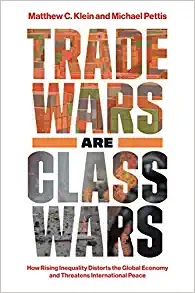
“Trade Wars are Class Wars – How Rising Inequality Distorts the Global Economy and Threatens International Peace” by Matt Klein and Mike Pettis, 2020

This is another book whose title only grazes its main topic.  Klein and Pettis are two Keynesians who analyze trade but especially financial flows to uncover what they feel is the basic problem with globalism as practiced under bi-partisan neo-liberalism.  It has led to austerity for the majority of the world’s workers, while leading to higher levels of personal debt, severe inequality among the classes and now trade and sanction wars which basically benefit elites.  It is a Keynesian 'under-consumption' argument that ignores production as the key to capitalist crisises.

Their solution is to restore the buying power of workers, especially in key countries like China, Germany/the EU, Japan and the U.S. through dropping the dollar standard and combating world-wide elite preoccupation with hoarding assets.  How this will be done without a new global class war is unsaid.  They take their cue from John Maynard Keynes, advisor to the British government in the middle of the 20th century.  Keynes suggested a stateless global currency, the bancor, at Bretton Woods in 1947 and a focus on broad consumption as the key to saving capitalism.  Instead the U.S. insisted on the dollar/gold standard and got it – even after the end of the gold standard in 1971.

But the book’s not that simple.  They take a historical tour through capital’s financial crashes since 1824, showing how excess capital accumulation in wealthy countries leads to credit booms and over-lending to dubious clients, starting first in Latin America.  These colonial/imperial banking flows led to subsequent world crashes in 1837, 1867, 1873, 1890, 1905, 1931, 1981, the significant Asian financial crisis in 1997 and the Great Recession in 2008.  The recession of 2020 is yet to be analyzed.  They do not look at profit rates from production.

The 2008 Great Recession was of this familiar type.   They pinpoint one of the causes of that recession as the need for ‘safe’ fixed income investments in the U.S. by European rich people and capital market banks, which ‘forced’ Wall Street to come up with fabricated mortgage securities.  Essentially the Europeans (read Germans) and Chinese were not spending enough on their own countries and on their own working-classes, so their capital had to go somewhere.  Since the U.S. is the ‘safest haven’ due to the world-wide dollar standard, corporate and elite money pumped into U.S. markets in various ways, including T-bonds.  This cash provided part of the large capital market for collateralized mortgage/debt obligations, which were based on shoddy and even illegal ‘due diligence.’  This is what precipitated the 2008 financial collapse as an immediate cause.

The authors identify the failure of pure ‘trade’ data to account for actual international economic flows, given corporate and rich people’s tax avoidance, intellectual property and patents, tax havens and production methods by major international corporations using complex value chains.  Which is why the authors add financial flows, using ‘current account’ figures for each country to combine the two, trade and finance.  As to trade, they seem to imply they are ‘free traders’ but do make criticisms of NAFTA, the TPP and TIPP.  Oddly for a book of this title, they pretty much shy away from the political details of these pacts. 

They call the dollar standard a burden for the proletariat, not an exceptional asset, but its political use by the corporate elite and their government lackeys is exceptional.  As one example, the elites can bar trading in dollars for countries like Iran, Syria, Venezuela and Russia, crippling their abilities to function on the global market.  Oil, the key commodity in the world, is denominated in dollars, as are nearly all international trade transactions.  Countries go into debt in dollars or dollar-denominated assets or peg their currencies to the dollar, all of which gives U.S. capital and its banking system vast power across the world. 

One of the authors, Pettis, is stationed in Beijing and there is a long and valuable chapter on infrastructure over-production and elite wealth hoarding in China, having a deleterious effect on Chinese workers, leading to under-consumption by them.  Under-consumption involves Chinese policies like the banning of independent labor unions, the hukou system, weak retirement/medical programs and the mass purchasing of U.S. Fed bonds by the Chinese government.  Again, they do not look at profit rates in China.  No word on Chinese billionaires though, as the authors support privatization.  They do not think China is capitalist, as they recognize the government has control of the upper and mid-levels of finance, industry and politics.  They identify the Chinese ‘elite’ at one point as government and state industry, not the private billionaires inhabiting the economy and even the Chinese Communist Party.  China’s Belt & Road initiative is described by them as providing an outlet for Chinese exports and construction efforts, which might be interpreted as excess capital. 

Have I Got an Austerity Plan for You!
In another long chapter the authors cover the austerity policies of Merkel’s German CDU, policies which were actually initiated and endorsed by the German Social Democratic Party against the leftist Die Linke and later exported to the whole Euro-zone.  This after the wholesale swallowing of East Germany in 1989, which cost more than expected.  Interestingly Germany has not invested in infrastructure, as its bridges are falling apart and its fiber installation lags behind many other poorer European countries, this another consequence of their balanced budget obsession.  Klein/Pettis call Europe the biggest threat to the world economy, which seems a bit rich.  The U.S. comes in for less blame because it is the exception that ‘consumes’ and also sucks in investments. 

The authors characterize countries as to consumption - either ‘surplus’ or ‘deficit’ countries, ‘savers’ or ‘buyers,’ the former relying on exports and a paucity of local investment and low pay, while the latter serve as buyers of other countries’ exports, the U.S. being the prime example of the latter.  This capitalist imbalance - combined and uneven development - affects the proletariat world-wide, as austerity becomes the fate of ‘saver’ proletarians while debt becomes that of ‘buyers.’  According to Klein/Pettis while being a government-led ‘saver’ society might make sense in the initial phase of an economy as a form of ‘primitive accumulation,’ (they reference the USSR, China, even the U.S. on this…) it becomes a hindrance in a maturing economy.

The authors thunder against inequality and wealth and propose modest reforms to lessen inequality, but not to eliminate it.  In their analysis they remain unaware of labor exploitation and profit, seeing consumption as key.  They actually whine about how long longshoreman took to load and unload ships before containerization.  Yet inside ‘mature’ over-producing and over-accumulating capitalist economies the need for more ‘stuff’ begins to slow and economies can stagnate, but Keynesian logic is still based on GDP growth.  They pine for a perfect GDP trade and financial flow balance between nations in a world-wide system, satisfying consumers everywhere.  They seem unaware that the class system itself is the cause of the class war, and capital is based on classes, not consumption. Inequality and imbalances are merely a placeholder for the underlying reality of surplus value, profit and subsequent upper-class wealth.

This book is sometimes complex for the general reader, as these two are both sophisticated economists. It is full of useful and numerous graphs, statistics and percents supporting their positions.  It indulges in a very slow progression toward their main contention that class war results in trade war, but if you can hang in there it makes sense in the end.  They do not spend much time on the issue of peace and war.  But even to them it is transparent that the U.S. ruling class bipartisan consensus – that’s the heroic Democrats and the dastardly Republicans - has moved to an economic and military ‘cordon sanitaire’ around China.  These moves can be preludes to actual military conflict in an imperialist-dominated world.   Beware.

Other prior blog reviews on this subject, use blog search box upper left:  “Modern Monetary Theory,” “Value Chains,” “Socialist Revolution,” “USMCA Fraud,” “What is the Matter With the Rural U.S.?” “Capital in the 21st Century” or the word “China.”

And I bought it at May Day Books!
Red Frog
July 10, 2020

Monday, July 6, 2020

A Little Berlin in Bavaria

"Line of Separation” -1st-2nd Seasons directed by Alex Dierbach, 2015-2019 on PBS


This series is based on the transformation of East and West Germany after the end of the 2nd World War.  It focuses on a small rural town in Bavaria, a ‘little’ Berlin called Tannbach, split down the middle by a small stream, then politically between East and West, then by an actual wall.  The first two seasons cover the period between 1945 and 1968, ending with the Warsaw Pact intervention into Czechoslovakia. 

Crossing the Line

The series starts with the defeat of the Nazis, who linger on in Tannbach, a stronghold of rural Bavarian fascists who resist U.S. soldiers and kill a Countess who wanted to surrender even after the Nazi collapse.  Hidden Nazis slip away, many of whom eventually end up in the Western sector, though a few hide in the German Socialist Unity Party (SED) in the east. The Western ex-Nazis play a hardline role as the most anti-Communist, sexist, cruel and right-wing.  Even with evidence, they are not convicted of war crimes as they have become useful to the West. The handsome war criminal and former Nazi Count becomes an agent for West German intelligence. He later becomes a target of East German intelligence himself.

Of most interest to leftists and Marxists are the developments on the eastern side, which is handed over to the Soviet Army after the departure of the Americans.  They have less truck with Nazis.

The series shows the initial idealism of the East German Social Democrats and Communists, who want to transform the East into a place without rich people, large landlords and exploiters.  An experienced Communist from Berlin arrives to supervise the transition.  Given the rural nature of the town, farming plays the key role.  The large estates are broken up and wealthy landlords are deported – to where we do not know, but perhaps to the USSR.  Their land is given in too-small allotments of 5 hectares to the landless.  Cooperatives are later formed, the main one centered on the former massive estate of the local Count.  A preacher in East Tannbach who is a former Communist continues to run a cheery church, even though the official ideology is non-religion.  As CP control tightens, small private businesses like cafes or food stores are also turned into cooperatives.  Later a fashion show is shut down by a new hard-line local leadership.  One loyal Social-Democratic baker is expropriated too.  Small private milk farmers that own under 80 or so hectares are allowed to function, but then some of them are expropriated due to their closeness to the border.  One of these ends in a singular tragedy.

Some of these clumsy didactic moves reduce productivity and food production, resulting in food shortages.  Petrol, tractors and spare parts are in short supply from the industrial sector over different periods as well. This reflects the whole industrial policy of the Warsaw Pact, when production and trade cooperation between the new workers’ states was vetoed by the bureaucrats in the USSR, so they mostly had to rely on their own resources & cash or the USSR. As a result, a shortage of consumer goods is also apparent.  Residents resort to smuggling goods from the West and aiding people leaving for the West. Though as one person explains, without the Marshall Plan West Germany might have been as poor as the East, so international capital is key.  West Germany begins to develop a commodity economy and East Germany suffers in comparison.  A left-wing Jewish smuggler going to a Christening is shot going through the wire, the first in the sector, which is blamed on the Western guards until the truth is known.

The Countess Confronts the Last Nazis

As the years go by, the initial leftist enthusiasm dims as more restrictive and military steps are taken against the population, as well as the building of a wall along the river in the middle of this little town.  Before that families could travel back and forth, but now some are split. Though one grandmother yearns for the quietness and low-key life of the Eastern sector and returns from the West.  The wall originates because of the realities of sabotage and perhaps an overblown threat of an invasion by U.S./German armies, which are caught stockpiling arms near the border. The leading agricultural comrade is demoted and sent back to Berlin because of his closeness to the population, and he’s replaced by a rigid former Nazi.  The leading Communist characters, Friedrich and Anna, begin to have conflicts with the harder line and this is shown in Friedrich’s opposition to foreclosing on a small farmer and Anna being forced to sign a petition supporting the Czech intervention.  Anna is demoted from being head of the farm co-op for her changing views.  Berlin ultimately gets its own wall in 1961 as people vote with their feet and flee the East.   This exodus is the equivalent of a union being slowly decertified by its own members.

Erich Honecker was the leader of the SED after 1971, and organizer of the Berlin Wall in 1961.  East Germany was the first to volunteer troops to invade Czechoslovakia and stop Dubcek’s ‘socialism with a human face,’ so in the Warsaw Pact they were the most hard-line.  The two seasons end with this intervention, which undermined the bureaucratic Communist claim to be ‘for the people,’ especially among the eastern population.  Support for ‘socialism’ dropped precipitously in the Czech and Slovak populations after the military move into Prague.

The third season starting in August 2020 will supposedly follow the story from 1968 until 1989 and the collapse of East Germany.  It is clear the writers are trying to give a partially-balanced picture, but they cannot really do that given their mostly capitalist sympathies.  After 1989 and the absorption of East Germany into Germany, the standard of living of the whole German working class deteriorated, and that remains to this day.  Only the upper 10% of the western population ultimately gained. The collapse of East Germany severely weakened the labor movement in both West and East Germany and that story will not be told by this series.  Eastern Europe became a cheap labor and raw materials sink for European capital, which was always the point.

What is clear is that East Germany was in a difficult position – a country split in half, like Vietnam and Korea.  It was controlled by Soviet troops, then Soviet political control, so it had limited autonomy.  Economically the failure to fully integrate the Eastern European countries hobbled them.  So did bureaucratic control by the USSR, which transported their methods of top-down Party control and reliance on military actions into each country.  Soviet or workers’ democracy was off the table.  Investments went mostly to security, with consumer goods somewhat ignored, which actually undermined each deformed workers’ state in a more subtle way.  Opposing blue jeans, rock music or other trivial ‘westernisms’ was a pathetic culture war version of real class struggle.  In spite of the initial enthusiasm by Communist and Social-Democratic workers, farmers and businessmen, the East German imitation of Stalinism was inadequate to win this battle in the class war.

This series is a good dramatic introduction to some of these issues, as the former workers’ states are consistently ignored in the U.S. as if they didn’t exist or when depicted, shown as repressive cartoons.

Other prior reviews on this subject, use blog search box upper left:  “Russia and the Long Transition to Socialism,"(Amin) "All Power to the Councils!" "Ghost of Stalin," (Sartre) "US/EU Meddling," "The Contradictions of Real Socialism," "Secondhand Time," "Welcome to the Desert of Post-Socialism."

Or reference movies and series: “Goodbye Lenin,” “Deutschland 83,” “Deutschland 86,” etc.


The Kulture Kommissar

July 6, 2020

Thursday, July 2, 2020

Anti-War Vets Will Turn It Off

“Da 5 Bloods”Netflix film by Spike Lee, 2020

Lee has made a movie about a group of U.S. black soldiers who fought in the American War in Vietnam and then return for a ‘visit.’  But when they get there it is more like a re-run of that war and they’re still not on the right side.  It is a buddy/heist movie whose lead character Paul is a MAGA-hat wearing brother suffering from PTSD.  4 of the ‘bloods’ arrive in Vietnam / Saigon / Ho Chi Minh City to recover the body of their 5th ‘blood’ – ‘Stormin’ Norman,’ who died in a helicopter rescue mission and was left behind.  And oh, to get 80-100 ingots of gold they buried while on that mission.  Evidently wearing all that Hollywood bling is starting to rot Lee’s mind. 

Stormin’ Norman was  a ‘60s radical, so they attempt to square his ideals with their greed.  It doesn’t work, even with clichéd overtones of ‘money is the root of all evil.’  Paul is oddly joined by his son David, who watches his father melt down in the trek through the jungle.  

What is wrong with this movie is that the Vietnamese – barring a prostitute one of the bloods had a baby with, and a former pro-U.S. ARVN guide – are all shown as angry or neo-Viet Cong killers and thieves, oddly allied with a scheming Frenchman.  So we have 2 MAGA stereotypes to hate.  The battle is over the gold of course – CIA gold.  The bloods claim it is their own and so do the Vietnamese.  If you think about it, it is on Vietnamese soil so it belongs to Vietnam, especially as payment for that brutal and destructive war.  It might even have had South Vietnamese government origins.  But instead here CIA equals ‘Black America’ and these are ‘reparations!’  No mention of reparations to Vietnam.  Gun battles ensue, the evil Frenchman and his Vietnamese allies all die and the remaining American heroes get the gold.

They partially donate some of the money to Black Lives Matter and a land-mine clearing group in Vietnam as sort of a moralistic laundering operation, set to irrelevant shots of MLK and Malcolm X.  And all is right in this stupid and fake world.

In the real world U.S. GI’s returning to Vietnam are not called ‘baby-killers’ or accused of killing someone’s ‘mama-san or papa-san’ by random Vietnamese.  They don’t go back for gold or even bodies.  They tour the battlefields, maybe revisit where they were stationed and perhaps help Agent Orange or mine-clearing programs in Vietnam.  They meet with government officials or former NVA/NLF soldiers.  They drink in the bars and take the trains or boats. Some even return to live and build a home.  If they have kids, they might actually bring them back to the U.S. or visit them on a regular basis in Vietnam – they don’t just bestow a cheap kiss. 
         
Vietnam Veterans Against the War (VVAW) March in 1972 NYC
Nor would NLF troops allow a crashed plane to sit on the jungle floor for even a second without checking it out.  Unlike Lee’s quartet, most black soldiers strongly opposed the war and some acted on that.  This crew is mostly apolitical about the war, in spite of their references to Norman. The film also implies that armed criminal gangs operate freely in Vietnam, even though Vietnamese gun laws are totally restrictive regarding civilians.  As to bodies, the American War in Vietnam (AWiV) has the most recovered bodies of any U.S. war in history, so this narrative just shadows those damn MIA flags that fly over police stations.  Paul even claims early-on that he was called a ‘baby-killer’ when he returned, another right-wing Vietnam myth, so bad that a whole book has been written about them.  So much MAGA bullshit here…Rambo would be proud.

The liberal fantasy movie Black Panther also oddly identified with the CIA, the U.S.’s state security service.  The CIA has been implicated in assassinations, funding and covert wars in support of apartheid and against black nationalism and black revolutionaries.  They played a role in assassinating MLK. So is CIA gold ‘black’ gold?

Lee’s last movie, BlacKKKlansman, was a paen to a real African-American cop who infiltrated the KKK (and also an anti-racist group, the International Committee Against Racism, which Lee does not mention.)  But as we know, some police across the country are closely associated with various rightist and racist groups.  So whose police story do we believe, Lee’s or our own lying eyes?  That applies to this movie too. 

So what is up with Lee?  His net worth is now $40M, he is a tenured professor and owns a film production company.  He lives in a 9,000 square foot town-home on Manhattan’s Upper East Side and has an estate on Martha’s Vineyard too.  That’s what!       

Other prior blog reviews on this subject, use blog search box upper left:  “Red Hook Summer,” “BlacKKKlansman,” (both by Lee) “Malcolm X” and “Black Panther.”

The Kulture Kommissar
July 2, 2020

Monday, June 29, 2020

Now for Something Completely Different

“Far From the Madding Crowd,” by Thomas Hardy, 1874

Far from the maddening crowds in London is Wessex, a rolling land of farms and villages in the English southwest near the coast, including the possible towns of Casterbridge and Weatherbury.  Wessex plays much the same role for Hardy as Faulkner’s haunted Yoknapatawpha County in Mississippi does – a ‘place’ he set his literary roots. 
 
The plot?  The effect on a few lonely men in a small, weather-beaten town when a young and beautiful woman – Bathsheba Everdeen - arrives and becomes a prominent farmer.  It is like a bomb going off.  Though vain and haughty, three men are struck by her beautiful fragments – a smart, young sheep-herder, a block-headed gentleman farmer and a roguish, profligate soldier.  Twisted love in all its blandishments results.  Hardy favors the capable sheep-herder over the twain, but not Bathsheba, who makes a coltish mistake.  A discerning reader may weary of their tiresome obsession with Bathsheba.  It does not end well as you might divine, but then it does.

A cast of men and women farm workers harvest corn, oats, wheat or sheer sheep and take care of livestock, while house servants cook and clean.  Bathsheba calls them 'the workfolk.'  They are the Greek chorus that grounds this tale in material reality and labor.  Oh, and one malter to get them all happy. The old sheep-shearing building on the farm looms great in unchanging significance, far above any castle or church. Wool has more meaning than religion or military power in this bucolic tale. These are the people that do the work and they are not mere background.

Upon these simple rustics are visited the qualities of tragedy and comedy experienced by archaic kings.  It seems at the same time that every man-jack can sing or play or is required to, as the brightest times are done up in fiddle, tambourine, dancing, ale and cider.

The class issue is very clear, as Bathsheba Everdeen goes from young and broke to the owner of a large estate through inheritance.  Part of her attractiveness is her money and status, unlike any poor but handsome washerwoman.    Bathsheba becomes the lady of the house and runs the farm herself – something few women would attempt at this time. 
 
A romance or a story of collective labor?  PBS 'workfolk'
In the story, small things lead to great calamities.  An overly-enthusiastic dog; a silly Valentine; a broken fence; a boot-spur.  Ignored nature plays its part in fire and rain. Beware.

Details in abundance overflow.  Nature’s every budding flower, trilling bird and blowing storm gets its time.  Emotions down to the last grimace, blush, stutter and thought.  Class always overhanging.  Early feminism’s reluctance to marry, as Ms. Everdeen is a comely modern woman.  Her marital hesitation is unexplained, then oddly broken.  And there is humor – Hardy makes fun of them all, unbeknownst to the players.  This includes his cynicism towards religion.  Here the dullest bullocks crib their thoughts from the Bible.

Old words, clichés and phrases pepper the text.  The book involves many convoluted paragraphs that only resolve into understanding at their termination.  Even the names have obvious significance: Bathsheba Everdeen, from the lustful Bible and Anglo-Saxon farmsteads - her last name echoed in the Hunger Games films; Oak, the sheep-herder; Boldwood, the older farmer; Troy, the soldier.  Like southern gothic, English gothic also invites a death or two.  We ape the writing of the greats – ‘tis normal for a lowly scrivener.  Enjoy!

Other prior blog reviews on this subject, use blog search box, upper left:  “Jude the Obscure” (Hardy); “Independent People” (Laxness). 

Bought at Chapman Street Books, Ely Minnesota.
The Kultur Kommissar
June 29, 2020

Thursday, June 25, 2020

Is MMT TNT?

“The Deficit Myth – Modern Monetary Theory and the Birth of the People’s Economy,” by Stephanie Kelton, 2020


Reading about MMT is a little like being Mr. Natural in an R. Crumb comic when his head goes ‘bleewy’ after eating an Alice in Wonderland upside-down cake.  It turns the conventional political logic on its head.

Cartoon Thinking - U.S. With Empty Pockets

Kelton was a somewhat conventional Keynesian economist until she started to look into how monetary and fiscal policy in the U.S. actually works.  She was hired by Bernie Sanders in 2015 as the Democratic Party economist for the Senate Budget Committee, but found that both parties believed in what MMT'ers call the deficit myth, even Sanders.  What is the deficit myth?  It is a bundle of deceptive understandings, but at bottom it claims that the U.S. government has to pay for everything through taxes or budgeting, even with a sovereign currency. (Not every country has one…)  This ignores the ability of the U.S. government to create money. Because of this household economy mentality, the deficit or debt becomes a scare tactic that has to be avoided at all times. Yet MMT indicates that Congressional approaches like PAYGO, debt ceilings, budget scores and the Byrd rule are essentially useful fictions for not just Republicans but Obama, Biden, Schumer and Pelosi too.  In effect the whole political regime is partially lying to us.

As anyone paying attention or studying history knows during the Depression, World War II and especially after the end of the gold standard in 1971, federal U.S. debt doesn’t actually matter. It is basically just an accounting fact, not a real debt.  After 1971 and especially recently the massive defense budgets, the huge tax cuts for capitalists and the rich, the repeated trillion-dollar rescues of Wall Street and the financial system, even the present pandemic funding, show that no one asks at the time ‘how will we pay for this?’  It is because the capitalists and their political lackeys already understand the government deficit is a present myth, but persist in the illusion for the rest of us in order to cry poverty and impose different versions of austerity on the U.S. working class.

Modern Monetary Theory (MMT) challenges the notion that a country with a 'sovereign currency' can run out of it – unlike a normal family with a budget, a U.S. state or a corporation. Kelton thinks that the real purpose of federal taxes should be limiting inflation, encouraging certain behaviors and creating equality – not to raise money.  MMT claims that spending comes first in the federal budget, not taxes and borrowing, which come later.  Marx maintained that money comes into its own in a commodity economy, originally starting as a commodity itself and is based on labor and leads to profit.  MMT disappears all this, per Keynesianism.  MMT'ers think money was created by the government to pay taxes.  For MMT inflation is the real problem, as a country with real full employment, which MMT supports, can overheat and generate inflation.  However, this debt in a capitalist context can lead the markets to react negatively.  Kelton says the most important issue is use-values – the real benefits that exist for the population - not what the accounting ledger is saying.

Kelton organizes the book around her list of MMT myths propagated by this  narrative, though she almost never mentions capital or classes.  We’ve all heard these stories our whole lives: 

Myth One:  The U.S. budget is like a household budget.  She mentions that the Republican head of the Senate Budget Committee in 2015, Mike Enzi, used to run a shoe-store in Wyoming and he understood the U.S. budget as if he was running a shoe store.  Unless a household or shoe store has an untraceable $20 printing press in the basement, they are totally different.

Myth Two:  Deficits are created by over-spending.  According to MMT, the evidence for overspending is inflation, not the deficit.  She references Japan’s enormous, long-running deficit and minimal inflation.

Myth Three:  The National Debt is a burden on everyone and will have to be paid back.  Actually the deficit hawks and doves are both wrong, as the national debt is mostly a number on a computer.  Treasury bonds will always be paid off, even though they really aren’t for raising money.  According to MMT it allows the Fed to drain excess reserves and hit interest rate targets.  But it also fills the coffers of the banking industry with interest payments.

Myth Four:  Government deficits impede private investment.  The deficit actually adds to private and state wealth, as a negative on one side of the ledger is a positive on the other side for individuals, corporations and states.

Myth Five:  The trade deficit means the U.S. is losing.   A trade deficit is evidence of a ‘stuff’ surplus.  Again, a negative on one side, a positive on the other.

Myth Six:   Entitlement’ programs like Social Security and Medicare are financially unsustainable.  Kelton ignores the more common fixes, like raising the SS tax level.  MMT says the U.S. can never run out of money, so no program that is legally required can fail as long as real good and services exist to support it – like hospitals, medical staff or medicines.  Kelton recommends making Social Security and the rest of Medicare legally required.

It is Easier to Create Digits on a Computer screen but...
Kelton then discusses the deficits that really matter in the U.S.:  Jobs, education, infrastructure, climate, health care and democracy deficits, not some abstract math figures on a spreadsheet.  She claims that with a proper understanding of money through MMT, a ‘people’s economy’ can be constructed.  She optimistically and naively thinks that the U.S. can use these same methods internationally, as the dollar is still the world’s reserve currency.  Financially weak countries in the world that peg their currency to the dollar, or that borrow in currencies other than their own, or are in debt in dollars are at a disadvantage and cannot be said to have a ‘sovereign’ currency - which is the majority of countries.  

Kelton’s most consistent program idea is a public jobs program that hires everyone who is unemployed or under-employed at socially useful tasks, with adequate wages and benefits.  Socialists have called for this for years and even FDR adopted it.  This is the public jobs option.

Now more negatives, as like Universal Basic Income, MMT is also a modern argument for some strategies of capital. 

Problem 1:  Fiat money is already the method by which the government props up Wall Street, the defense industry and the Pentagon and hands out billions to corporations and the wealthy in tax breaks.  They never ‘pay’ for this funding, these tax breaks, these almost zero-interest loans or asset-purchases, they just credit these entities from a computer at the Federal Reserve or the Treasury or sell Treasuries they know they can pay off. 

Problem 2:  If you don’t need taxes to fund the government, then the corporations will argue you can leave tax havens, tax loopholes, rich individuals and billion-dollar corporations alone.

Problem 3:  An economy that is operating at ‘full capacity,’ as planned by MMT, will still be an economy without environmental sustainability and social controls, along with labor exploitation. I.E. there is no sense of planning or workers power here.  Quantitative easing has not actually created a fully functioning economy, even with the trillions injected.

Problem 4:  The MMT argument implies that both capitalist parties will settle their factional disputes.  This implies that each wing of capital behind each party now have the same particular interests, when they actually don’t.  While united around supporting capitalism, they differ on what capitalist groupings to prop up.

Problem 5:  MMT is a form of Keynesianism.  Capital relies on scarcity and if money is no longer scarce, then capital is weakened.  Capital relies on unemployment to discipline the proletariat, so a permanent public jobs program will also weaken capital.  Capital relies on deficit myths in propaganda, so if these myths are punctured, capital is weakened.  U.S. capital is based on imperialist exploitation of labor and countries in other parts of the world, including its use of the dollar standard.  As a result, few countries in the world actually have a 'sovereign currency.'  Capital relies on profit through labor, but MMT will negatively impact profit and in fact does not understand that money and crisis is related to profit problems.  Instead she believes that “capitalism runs on sales,” not production, as befits a Keynesian.  Will capital give up these advantages?  Felton believes that their ‘misunderstanding’ of fiat currency is just that, and that if only the capitalist politicians would ‘see the light’ the world would change.  She has ignored politics, profit and classes in the process.  

Problem 6:  Taxes and budget changes actually DO provide some funds.  MMT claims they are totally unnecessary for funding.  For instance, she does not discuss the looting of the Social Security Trust fund by politicians to justify other expenditures.

Problem 7:  Felton couches her optimistic narrative as something that will benefit ‘all,’ thus evincing no understanding of class politics, productivity, labor or capital.  She is a professor at Stony Brook University, so her class position as part of the professional strata of the middle class may have something to do with this. In this sense she is quite conventional - but her promotion of MMT is not.

At any rate, a very useful book to understand some aspects of capitalist monetary & fiscal practice, not the one you learn in school or in the propagandist media.   But it ignores the Marxist view of crisis and labor exploitation.

Other prior reviews on this subject, use blog search box, upper left:  “Debt & Capital,” “Debt – the First 5,000 Years” (Graeber); “J is For Junk Economics”(Hudson); “I’m a Gettin’ Gone,” “The American Jobs Bill Speech,” “Who is Ron Paul?” “Paul Krugman & the Class War,” “A Culture War Debate,” “Lockout Over,” “Zombie Capitalism.”         

P.S. - Here is a harder take on MMT from the International Marxist Tendency: 
Marxism v MMT. Marxists oppose MMT as a superficial analysis of capital.

And I bought it at May Day Books!

Red Frog

June 25, 2020