Saturday, March 30, 2013

Geographic Fundamentalism

“Guns, Germs & Steel – the Fates of Human Societies,” by Jared Diamond, 1999

This is the book that really brought Diamond to world attention, and was followed up by “Collapse” which took the same themes and focused on social failures in history.  (“Collapse” is also reviewed below.)  It is probably one of the seminal geography books published in the last 15 years.  Diamond essentially wrote this book to oppose the theory that either genetic or cultural factors in certain populations doomed them to be social failures, and that the alleged superiority of European or north American genes, culture or economics made it possible for them to rule the world.

The book is clearly written and detailed, though not quite so dramatic or overtly political as ‘Collapse.’  It could be read as a geography textbook.  He pivots on the famous meeting of Pizarro and the Inca Emperor Atahuallaca in the Peruvian city of Cajamarca.  After inviting him to a meeting, Pizzaro ambushed Atahuallaca with horses, guns, armor and swords and captured him, while routing and killing thousands of Incas with a tiny force of 158 conquistadores.  How could something like this happen?

Diamond bases his theory on careful geographic and environmental analysis, avoiding any hints of social idealism or myth-making, and as such, gives a materialist view on the origins of human civilization.  This book bases itself on environmental conditions, but it only goes to a certain point in history.  It focuses on the development of class structures leading to technologies that gave one society an advantage over other societies.  According to Diamond, that class structure was originally based on the development of agriculture and the surpluses derived from agriculture, a point Marx and Engels also made.  In Diamond’s telling, agriculture ultimately originates from the specific physical environments each society or group of people found themselves in accidentally.  These environments were not general to all parts of the world, but were specific to certain continents, and parts of continents. 

Just as Darwin used the Galapagos islands as a laboratory to study evolution, so Diamond uses mostly isolated or island cultures to study the evolution of societies.  In this book he has separate sections on Australia and New Guinea; China; extended Polynesia; the collision of Eurasia and the Americas and Black Africa.

Diamond maps the origins of the key grains, legumes and domestic animals in history, locating the most important geographic areas in the world – the main one being the ‘fertile crescent’ arching from Palestine, Lebanon, Syria through Iran, Iraq and Turkey.  This area was one of the first sources of agriculture, based on the superior environmental conditions present at that time – wet winters, dry, warm summers, varieties of elevations, the presence of certain key, easily available wild plants containing much protein – wheat and barley; lentils, peas, chickpeas and vetch; flax, source of clothing, rope and fabric; and wild mammals that turned into 4 of the 5 key domestic animals to this day – pigs, sheep, cows and goats.  These domestic animals were sources of food and work.  The Fertile Crescent was a virtual cornucopia of valuable agriculture, ripe for the taking.  Other areas in the world where herding and agriculture development began independently – China, Mesoamerica, New Guinea and secondarily, the Mississippi Valley; Peru and perhaps the Sahel – did not have as many natural positives as this environment according to Diamond. 

The development of agriculture can lead to surpluses, which leads to people who do not grow food, but specialize in other skills.  It leads to hierarchies, to population growth, to new technologies developed by the specialists, to writing and eventually conquest.  A hunter-gatherer society cannot withstand an attack by such a society.  Hunter-gatherer societies, inherently equal and communistic, would only transition to agriculture if the land supported such a process - and if hunter-gathering had reached its limits.  And this was not true in all locations.

Another benefit the Fertile Crescent had as a locus for agriculture was it allowed its discoveries and technologies to spread east to west along latitude lines, from the Atlantic to India’s Indus Valley, and just north into Europe.  No natural barriers existed, according to Diamond, even given the Bosporus.  However, in East Asia, the ocean blocked agricultural development south into the islands and Australia and so did the jungles south of China.  In Africa, it was the Sahara.  In the Americas it was the tiny isthmus and the jungles of Central America and the north Mexican/south U.S. desert.  Diamond calls this east-west geographic orientation fundamental for the spread of technologies and disseminating agricultural knowledge.  North-south dissemination proceeded with great difficulty.

As we know from AIDS and most other diseases, they originate from animals and then jump to humans.  The more pets and domestic animals a society has, eventually the population develops anti-bodies.  The less domestic animals, the fewer anti-bodies.  Far more Native Americans died from disease than warfare in the conquest of the Americas.  Why?  Because the Mississippians, the Maya and the Inca were more vulnerable to the crowd diseases of the conquistadores like De Soto, Pizarro and Cortez than their swords.  This happened because the Spanish and other societies in what Diamond calls the continent of Eurasia had adapted to domestic animal diseases.   The Inca only had llamas, and were more vulnerable.  Though this is not all just a one-way street - malaria and other tropical diseases have kept Europeans at bay too.

Diamond also traces the development of writing to the development of highly-organized agricultural societies.  The first writing was developed in Sumeria in the Fertile Crescent – used by officials to track purchases, debts and sales of the state.  Other independent developments of writing – in China and Mesoamerica for instance – did not spread as rapidly as in Eurasia, which eventually led to U.S. script – English via Rome and earlier, Greece.   He locates technological innovations not among individuals, but among societies with enough numbers and surpluses to come up with inventions.  He locates the amalgamation of bands, tribes and chiefdoms into states to either external military threats or military conquest, not to economic factors, and links the establishment of states to population density.

Diamond calls the bureaucracies in states ‘kleptocracies,’ but also reminds readers that the hunter-gatherer bands were devastated by individual murders.  He notes that patriotism, nationalism and religious fervor were useful in states as ideologies which allowed people to risk their lives and kill for the state.  As such, this might mark a ‘successful’ society, in the sense that it won in the Darwinian struggle for survival.  He does not mention Frans De Waal’s theories of cooperation, inequity aversion and food sharing as essential to group survival – as these might only operate within a society, and not between them. 

The obvious questions here are – A, if the original source of agriculture and domestic animals was in the Fertile Crescent, why did Europe become the source of colonialism and capitalism, not the Fertile Crescent itself?  As Diamond makes clear, these Islamic societies were more advanced than backward Catholic Europe during the dark ages.  B, why didn’t China develop along those very same lines as Europe, since it was an independent source of agriculture … instead of being subject to the Opium Wars of English colonialism?  And C, if Russia is in "Eurasia" what was the environmental disability that did not allow it to follow northern Europe so closely?  And D, since agriculture is not the end of economic society, how does Diamond explain capitalism in this environmental scenario, and its early development in northern Europe

Diamond takes on the issue of China by describing its early political unification in 221 B.C. – with a mainly unitary language, government, agriculture (millet, rice, dogs, pigs and chickens, water buffalo, bronze-making, silk worms, etc.), transport and writing system.  Descending from the north, the Qin Dynasty pushed out earlier language and social groups in southern China, who were forced to move further south to southern Asia - Vietnam, Thailand, Burma, Cambodia & Laos.  He points out that European diseases like the Bubonic plague, smallpox and influenza probably came from Chinese animals and populations.  Chinese merchants spread throughout southern Asia – its peninsulas, islands and lands – yet not as formal colonialists.  Ethnic south Chinese took over Taiwan, and Taiwan’s people incredibly then went on to settle all of Polynesia and nearly all the islands of South Asia.  But later, it was the French who seized Vietnam, Laos and Cambodia; the Dutch, Indonesia; the Americans, the Philippines; the English, Australia, Burma and China itself.

In response to the issue of the “Fertile Crescent,” Diamond points out that climate change rendered this formerly wooded and fertile land a semi-desert and desert, removing the head start it once had.  The humans in this area cut down their own forests, thus leading to desertification.  The benefits it generated instead accrued to Greece, then Rome, then after a gap of centuries, colonial Spain, Holland and eventually England – which then became the location for the birth of industrial capitalism.

Regarding Russia and its partial lag behind Europe, it was the Bolshevik revolution in 1917 that transformed the former Czarist kingdom, and pushed it into the 20th century at a rapid pace.  This did not result in economic colonialism or imperialism, unlike Europe.  Diamond does not deal with Russia at all.  In a sense, it was not the bourgeoisie that led the way here, but the working class. 

Regarding China, Diamond asserts it was a conservative, isolationist bureaucracy that controlled the whole country, and at a certain point in the mid 1400s, forbade shipbuilding and other advances in technology.  Because China was a unitary state, their word became a law that lasted for a long time.  Stagnation set in from the top, which is one of the dangers of over-centralization.  This could not occur in Europe, as there were too many separate countries.  In this book, Diamond tracks other instances of societies turning their back on technology and science for mostly political reasons.  Of course, even in the U.S., global climate change and evolution, for instance, are somehow still 'controversial' science. He calls China a ‘gigantic island within a continent’ – easily cut off from strong outside influences for many years.  And that is what happened - until eventually British ships appeared off the Chinese coast.

And I bought it at Cheapo Books.
Red Frog
March 30, 2013

Sunday, March 24, 2013

99 Channels and Nothin's On

“Four Arguments for the Elimination of Television” by Jerry Mander, 1978

Tired of your local cable provider?   Wondering why you change channels constantly?  Can’t find much to watch?  Shows you used to watch seem stupid?  Not loving commercials?  Crappy ‘genius’ cop shows finally too much?  (see review of cop shows, “Bad boys, bad boys” below.)  Perhaps you are experiencing the dreaded symptoms of … dung…television withdrawal!

Jerry Mander (yes, his real name) would understand.  This is a guy who used to work in advertising in San Francisco in the 1960s and early 70s, running his own firm, and ended up a proponent of Native American lifestyles and radical causes like environmentalism.  He is far from the stereotype of advertising executives as portrayed by those Mad Men mannequins swilling martinis during lunch.  Odds are Mad Men the TV show will never show his trajectory out of the industry, which only shows you the hidden meta-message of Mad Men's existence. 

Mander grabs every conceivable argument lying around in 1975 and 1978 to show that Marshall McLuhan’s idea of the wonders of the medium were doltish. 

Mander lays out his case for television as A, propaganda; B, brainwashing, brain-disabling and hypnotic; C, basically an advertising-delivery system; D, physically dangerous; E, anti-democratic; F, invisibly pervasive; G, addictive; H, profitable; I, un-reformable; J, isolating; K, an unreal experience; L, narrowly two-dimensional; M, shot through jump cuts to minimize the actual boredom contained within TV programs, and N, prone to creating geeks and geek trivia.  (Wait, that is not in his book…)

As you can see, there are more than 4 reasons, but Mander has grouped all these points into 4 separate sections, and goes into many aspects in detail.  His main point, which he argues against liberals who think television can be improved, is that television, as a medium, is not neutral, and can never be neutral.  It, by its very nature, works as a deadening eye in every household, no different than Orwell’s 1984.  This book was written before video and DVDs, the explosion in cable, and then the spread of TV onto the internet and shitty little screens on ostensible smart phones.   These seem to create a bit more control for the user, and break-down somewhat the centrality of control.  Yet behind nearly all the media in the U.S. is still 7 massive entertainment complexes – News Corp; Walt Disney; Viacom; Sony; Time-Warner; NBC-Universal and perhaps CBS comes in as the little brother.  So behind the riot of ostensible diversity?  Oligopoly, which should be the name of a board game. 

Mander at times extends his analysis to film and by association, long-form television, but does not really concentrate on that area.

The liberal argument about neutrality is that public networks like PBS or BBC and tiny local cable shows balance the 270 channels of dreck.  PBS itself is now a site for advertising by subtle corporate methods.  Its news programming is little different from corporate programming, just slightly less loud about saying the very same thing.  Occasionally there is a good show, but these cannot compete with the majority of stations.  HBO is the leader in quality long-form programming, but is too expensive for most of the population.  Cable stations that used to have promise, like the History channel and the National Geographic channel, far too frequently now fall into trivial sensationalism. 

As a former advertising executive, Mander understands that advertising is not some accidental or idiotic by-product of capitalism, but essential to creating demands for goods that would not other wise be bought.  (see review of Propaganda by Edward Bernays, below)  If you have toured enough stores recently, you know that nearly every store, everywhere, is over-stocked with crap that no one is buying.  That is where advertising comes in, on TV, on the internet, everywhere.  Advertising is the real voice of our capitalist age, not the accidental gibberish of a strange relative. It is the capitalist solution to overproduction.  As J.B. Foster put it in The Endless Crisis (also reviewed below), capitalism uses advertising as a substitute for price competition in an oligarchic situation. 

Now we are forced to pay for cable, and then forced to watch ads too.  Remember the old days when TV was ‘free’?  No more.  Of course, according to Jerry Mander, it was never free – except for the people who controlled it. Perhaps one day television will be seen, like tobacco, children’s cereals and smoking, as an unhealthy addiction.  But that will not happen in this society. Capitalism actually needs television and its offshoots as its main form of political control.  It does, quite simply, push the ‘line’ into our heads on an hourly basis – either obvious political points or more subtle cultural points that are nevertheless political too. 

Read also, Neil Postman’s, “Amusing Ourselves to Death,” and Huxley’s “Brave New World” for more on this subject.   The former centers on how the media becomes a narcotic, shaping our lives in the process.  Huxley feared that there would be no reason to ban a book, for there would be no one who wanted to read one. 

And I bought it in Mayday’s used book section.
Red Frog
March 24, 2013
Spring

Sunday, March 17, 2013

Two Diaries - One View

The Diary of Che Guevara:  Bolivia – November 7, 1966 to October 7, 1967;  Diary of BergenBelsen – 1944-1945, Hanna Levy-Hass

Diaries capture a feeling of reality that fiction and even non-fiction do not.  They are not ‘crafted’ documents for the most part, but details of daily or monthly life that might slip through the fingers of memory.  Certainly, in the case of Hanna Levy-Hass, the conditions in the camp worked to destroy memory. Bergen-Belsen, while not an extermination camp but a ‘work’ camp, was, as she put it, ‘extermination by other means’ – hunger, fatigue, sickness, theft, brutality, crowding, pettiness.  Levy-Hass’s diary is more intermittent – some entries cover an entire month, while Che’s are almost daily.  Her entries are more an interior monologue – not so much specific events as generalizations, attempting to keep a humanist consciousness about her in conditions of total horror.  Che’s are a dispassionate description of each day’s trials and successes on the paths of the guerilla – a mostly military analysis.   

Che's Bolivian diary
DIARY OF BERGEN-BELSEN:
Levy-Hass was also a communist.  She grew up in Belgrade, a ‘Yugoslav’ working-class Jew, speaking Serbo-Croatian ('Yugoslav"), and becoming part of the Yugoslavian Communist Party lead by Tito.  She worked with the partisans in her small area of Bosnia but made the fatal mistake of listening to the pleadings of reticent, petit-bourgeois Jews who urged her not to go into the mountains permanently, as their community would suffer reprisals.  Because she listened to them, she was swept up by the Gestapo along with the rest. 

The main mystery of the Holocaust is why there was not more widespread resistance.  It can only be laid at the feet of the rich and middle-class Jews who for the most part counseled patience, non-resistance and even collaboration. In Bergen-Belsen, this domination of the bourgeois and petit-bourgeois Jews continued.  The political prisoners were isolated in a special area, so it seems they were unable to affect the rest of the camp.   Levy-Hass clearly points to one of the Jewish ‘leaders’ in the Bergen-Belsen camp, a ‘former representative of the Swedish match trust in Yugoslavia,’ who fought against her ultimately successful attempt to divide food equally and not to pay bribes for food.  Some Jews worked in privileged sections of the camp and completely forget about the conditions of the vast majority.  She points out that the men in the camp were the worst, while the women at least had to consider the children. Levy-Hass:  “For too long, personal pleasures and convenience have been at the center of these people’s lives, to the point where privations become unheard-of and tragic things, and self-denial is unthinkable.  As for self-discipline, it is an unpleasant novelty that they cannot grasp and that they only accept as necessary for other people.” 

Levy-Hass worked as a school teacher in the camp, trying to keep the children in touch with something humane.  This with scraps of paper and a few books.  However, the camp gets worse and worse as the battles comes closer.  The Nazi head of Auschwitz, Kramer, is eventually transferred from Poland to Bergen-Belsen as the Soviet Red Army advances.  Any pretense at feeding the prisoners ended.  Eventually, they shipped the few remaining prisoners on a train, and Levy-Hass escaped while looking for potatoes at a stop.  She meets a Red Army officer and she finally gets some real food. 

Levy-Hass moved back to Belgrade, but no longer felt comfortable even in Tito’s Yugoslavia, which at that time did not concern itself with the Holocaust.  Her parents, other family members and most friends were all dead.  While not a Zionist, she eventually moves to Israel in 1948, though she could not find a teaching job there due to being a member of the Israeli Communist Party.  She stopping being an official Communist in the 1970s, and became a socialist feminist.  Yet, like many eastern Europeans, she and her husband retained a fondness for what the people of the USSR did by liberating them from the Nazis and their allies.  Levy-Hass leaves Israel for Europe and Paris in disgust after the 1982 Sabra-Shatila massacres, carried out with the cooperation of the Israeli military. While always hoping to return to Belgrade, Yugoslavia is torn apart by ethnic and imperialist civil war in the 1990s.  As she told her daughter, an activist who works for Palestinian rights, “All my worlds have been destroyed.” 

THE DIARY OF CHE GUEVARA:
This diary was first published by Ramparts magazine in 1968, with a fiery introduction by Fidel Castro.  It is missing a few days and there are certain illegible words, but the majority of the document survived destruction by the Bolivian Army and CIA when taken by the Bolivian Minister of the Interior and given to Castro.  This is an austere and grim book, tough to a fault, and, given what happened, full of foreboding.  Che traces the development of his guerilla band from a trans-national conglomeration of Bolivians, Argentinians, Cubans and Peruvians who never lost a fight - until they did.  The last entry does not show that Che really understood that they were surrounded or trapped. 

The betrayal of the Bolivian Communist Party under Mario Monje is here clearly laid-out.  While initially promising to help the insurrection, Monje cut ties and did not allow any aide or support. Monje did this with the backing of the bureaucrats of the USSR, though this is not in the diary.  (The book, “Killing Che,” a fictional account based on research, is one among many that clearly shows the Soviets sabotaging Guevara.)  Che’s guerilla force initially had about 40 members, but at the end, was down to 17 due to various reasons.  No reinforcements arrived, no recruiting was done from among the Bolivian peasants and the groups were split for a long period of time.     

The diary concerns everyday details like butchering animals to eat; paying peasants for services or goods; hacking trails through jungle or up cliffs; crossing rivers on rafts, setting ambushes; small battles, arranging the movements of the vanguard, the center guard and the rearguard; hiding weapons and food in caves, taking prisoners and stripping them to their underwear, getting lost, arguments, sickness, injuries and Che’s partially-treated asthma.

Through all this, Guevara never loses faith in what he’s doing.  Yet at the end of each month, he adds up the strengths and weaknesses of the guerilla and, while many positives are listed, the ominous negatives don’t change for the better.  There seems to be no plan other than wandering around the mountains and jungles and winning battles, hoping that the guerilla could destabilize the government of General Barrientos.  Barrientos, as was typical for many years in Latin America, came to power in 1964 through a CIA-engineered coup against a democratically-elected government.  Barrientos spoke Quechua, being of partial Quechua background, and thus had more support among peasants than would be normal.  There is unrest among the leftist miners at Siglo XX, and Barrientos massacres them, killing 30 on June 24, 1967 when they came out in support of the guerillas. Yet ultimately a contract is signed, and the miners go back to work.  So no mass support develops across Bolivia for the guerillas, unlike what happened in Cuba.

This diary, like Levy-Hass, is a unique historical document, written on a subject of deep interest to revolutionaries everywhere.  We can reflect that the U.S. treated Latin America as its backyard for a 100 years, intervening, overthrowing and undermining at will.  Today, almost the whole continent has rejected this neo-liberal economic and military platform. (See review of "Secret History of the American Empire," by John Perkins, below.) Yet the guerilla campaign in Bolivia in 1966-1967 was just part of a continent-wide war that still goes on.  Today, the U.S. Obama administration is once more preparing to undermine Venezuela, stationing thousands of troops in Columbia for a possible invasion of Venezuela.  Hillary Clinton’s “State Department” endorsed the recent military coups in Honduras and Paraguay against left-populists and spent much money trying to oust the Ecuadorian left-populist Rafael Correa, failing again.  The criminal boycott of Cuba continues.  The U.S. is still the main enemy of peasants and workers all over Latin America, non-withstanding the soothing dulcet tones of Obamaite ‘reasonableness,’ a song only a fool would believe.

And I bought both books at Mayday.
Red Frog / March 17, 2013

Thursday, March 7, 2013

Fire Holder - Don't Hold Your Fire

Eric Holder – The Obama Administration’s John Yoo

You got to hand it to this guy Holder – he’s put his foot in his mouth twice in two days – on serious issues.  And you thought the days of corrupt or incompetent legal counsel in the U.S. Attorney General’s office were over. 

It also goes to prove that the ‘ethnic’ or ‘gender’ litmus test sectoralist liberals like to put on high appointments is basically reactionary. Putting corporate women in office does not change corporatist government. Take three recent appointment by Obama of women.  One, Sylvia Burwell, is from the WalMart Foundation, now appointed as head of the OMB.  She used to be a Clintonite (from Arkansas, get it?) working with Wall Street’s Crown Snake, Robert Rubin.  Then there is Gina McCarthy, who was in Romney’s gubernatorial cabinet – I.E. a Republican - now selected to head the EPA. Former head of REI, an outdoor sporting supplies company, Sally Jewell, has been nominated for the Interior Department.  You know, sporting business women know the environment!   Oil-man Ken Salazar used to hold the Interior post, and was most notable here in Minnesota for removing wolves from the endangered species act, so that liberal millionaire Democrat Mark Dayton could get 500 shot.   (Commentary on the wolf hunt, “Crying Wolf,” below.)

I could go on, but the 2013 cabinet smells just like the 2008 cabinet. 

Back to the incompetence of Eric Holder.  He got his spurs, along with Obama Supreme Court appointee Elena Kagan, in winning a case in 2010 before the Supreme Court, “Holder v Humanitarian Law Project, 561 US.”  This case, based on the Bush Patriot Act, basically criminalizes speech about, to or for any organization on the U.S. government’s ‘terrorist watch list.’  (Maintained by Clinton’s, now Kerry’s State Department.)  In essence, it made talking to, interviewing, supporting in print, or otherwise verbally interacting with any group on the list possible ‘support of terrorism.’  Now, as you might be able to tell, this could apply to journalists, to political people, even to the well-meaning liberals at the Humanitarian Law Project.  The latter had talked to both the Kurdistan Workers Party and the Tigers of Tamil Eelam about using … non-violence instead of violence.  You got it.  This was branded ‘material support or assistance or expert advice’ to terrorism by a couple of lawyerly Democrats.

Now we won’t get into the names on this list, which of course are nearly all organizations that violently oppose U.S. interests.  We pick and choose our terrorists.  This ruling has now endangered members of the Freedom Road Socialist Party and anti-war activists, as they have been hauled before grand juries in attempts at prosecution.  (Commentary on the Grand Jury inquisition of the FSP, below, “Justice Department Brings Back Hoover.”)  Application of this act, of course, is optional, based on who the government wants to go after.  They did not put the Humanitarians in jail, they just ‘reserved the right’ to do so.  They ignored K-Street Beltway Republicans who campaigned for the anti-Iranian government MEK (‘Mujahideen e Khalq ) to be taken off the ‘terrorist watch list’ in 9/2012 after an expensive lobbying campaign. (Remember, expert advice…)  So one group of ‘terrorists’ supports U.S. interests, and that is OK.

Now, back to Eric Holder.  You can see how this guy has had an influence behind the scenes in increasing government police powers, contiguous with John Yoo, though a little diminished on the torture road. Torture-friendly James Petraeus was recently outed as continuing El Salvadorean Death Squad-style torture in Iraq, using some of the same people.  And then lauded by the Obamaites, only to be brought down by his own dick - nothing substantial.  We cannot forget Bradley Manning’s treatment, which was called torture by everyone but the Obama administration.  Black sites still exist, where the U.S. government shuttles people to torture – although now that Gaddafi is gone, we’ll have to make new connections in Libya. And then there is Guantanamo.

Yesterday Holder prompted a grand filibuster by Rand Paul on the issue of drones, and I have to say, about time someone addressed this question in a big way. Holder, in a March 6 speech at Northwestern “Law” School, said he is of the ‘opinion’ (no court has ruled, mind you) that drones can be used to kill American citizens abroad and … in the U.S. itself, without any due process.   I.E. if you are labelled a ‘terrorist’ or an ‘enemy combatant’ by the chief executive, you can be killed.  Constitution be damned.  You know what King George called the American revolutionaries?  Terrorists, among other things.

OK, to top this off, Holder just told the Senate Judiciary Committee on Wednesday that large banks and their executives are too big to prosecute.  This was the rationale the execrable Lanny Breuer of the U.S. DOJ used to justify not one prosecution in 4 years, just before resigning.   Breur was nailed by Frontline a few weeks ago, and also by Matt Taibbi (who’s book, “Griftopia”, is reviewed below) for saying this very same thing.  So its official - justice stops at the big banks' gates.  If we can’t prosecute banks and bankers because that would ‘bring down the world economy’ does that mean that the world economy is dominated by criminals? 

HSBC, a bank which was deeply involved in money laundering for Mexican and Latin American criminal cartels, the mafia, Russian gangsters and just about anyone else who needed money to hide in the world, was recently slapped with a fine, and told to go about its business – of ignoring SARS reports or AML rules at all.  Taibbi took HSBC and Breur apart in a recent Rolling Stone.  That is enforcement in the age of Wall Street government.

Eric Holder deserves to go.  Fire Holder.  Fire the whole Bushite ‘war on terror’ to boot.  

P.S. - March 16, the FBI (and by extension, the U.S. Justice Department) recently lost a lawsuit against Working Assets / Credo phone company over "National Security Letters' - which are basically secret subpoenas without any court or public oversight issued at the whim of the FBI.  Holder, of course, completely supports these Bushite letters.   

Red Frog
March 7, 2013

Saturday, March 2, 2013

The Hippies Were Right

Paul Krugman and the Class War

Krugman’s February 28th New York Times column on austerity brings back a funny analogy that the sober uber-liberals of our day rarely make.  Krugman points out that opposing the invasion of Iraq in 2003 made one a ‘foolish hippie’ to the elite pro-war consensus.  Of course, as Krugman intimates, the ‘hippies’ were right about that one.  Ben Bernanke recently gave testimony to Congress that, in Krugman’s estimation, counsels against austerity as a solution to joblessness, foreclosures and poverty.  Krugman asks, “Has Bernanke joined the ranks of the hippies?”  Krugman hopes that, when one of the Beltway class disagrees with the consensus, there might be a chance that the bi-partisan ‘elite obsession with deficits’ can be curtailed. 

Don’t count on it.   They’ve been hating on hippies since 1965, and before that, beats, and before that, bohemians.  Yet the hippies of the '60s and '70s were right about nearly everything.  Hippiedom was a world-wide phenomenon, not just limited to the U.S.  The hippies were right on the Vietnam War, on marijuana, on rock music, on environmentalism, on women’s liberation, on black revolution, on Chicano rights, on sexual freedom, on organic food, on the early roots of the internet.  Hell, even clothing – they made blue jeans a mass phenomenon. They also hopped on the internet first.

Which brings us back to Krugman.  The February 2013 Monthly Review quotes another Krugman column where Krugman the New-Born Hippie muses:  “Are we really back to talking about capital versus labor?  Isn’t that an old-fashioned, almost Marxist sort of discussion, out of date in our modern information economy?”  (Don't you love people who talk about the 'information economy" like we materially survive in an ethereal form by reading the internet!) In another blog entry he writes, “if you want to understand what’s happening to income distribution in the 21st century economy, you need to stop talking so much about ‘skills’ and start talking much more about profits and who owns capital. Mea culpa: I myself didn’t grasp this until recently. But it is really crucial.”  In another column he writes, “If income inequality continues to soar, we are looking at a ‘class-warfare future.’"

Welcome to the Hippie Club, Paul.  It might be noted that, in that day, tens of thousands of ‘hippies’ in the U.S., both western and formally 'Communist" eastern Europe, Mexico, Japan, Australia and other countries also supported Marxism in various forms.  So perhaps we were right about that, too.

If you want to look at the ‘class-war’ future, it is actually not in the future, it is now.  Across Europe, especially in the continuation of the revolution in Egypt, or in India and China, the working-class is stirring.  In Greece, Spain and soon perhaps Italy, mass demonstrations and strikes have been constant.  Attempts at an occupation of the Spanish parliament by the left was defeated by the police a few months ago.  Iberia Air workers recently seized the air terminal in Madrid.  However, no matter how many general strikes, massive demonstrations and anti-austerity parliamentary votes happen, unless the working class escalates, these tactics alone cannot win.  As Rosa Luxembourg pointed out (see review of “All Power to the Councils,” below) the parliamentary form of representative government is particularly suited to capitalism at its most efficient.  This form of government allows the capitalists to control the process through money, law, media and timing. It is what they used against feudalism. 

The working class has to develop its own form of government, which ultimately can be a form of dual power.  And that form of government is workers and popular councils, in worksites and in communities. That is ultimately how the working-classes can really control society.  This is what has happened in every single situation where capital is actually threatened.  Is it time now in Greece, in Spain, perhaps later in Italy or Latvia, that councils start forming as a form of political power over and against the discredited, unrepresentative and bankrupt parliamentary forms?

I think so.  If you see this happening, we will know that that ‘class-war future’ Krugman talked about has escalated another notch.  Of course, here in the U.S. there is a developing class consciousness, but no mass organizations capable of turning this into political gains.  The AFL-CIO and “Change to Win” federations sold their souls to the Democrats once again, and will not advance beyond what the Democrats decree.  The Democrats are a party of capital – nothing new here – so real progress cannot come through them.  The best thing that could happen is a split in that party, to form a left-populist labor-oriented party not allied with large capital. (See review of “The Democrats – A Critical History,” reviewed below.)  But that is unlikely in the near future.

Who is involved now?  It is the children of the original hippies who are now coming of age, in their 20s and early 30s.  It is the children especially, of the younger cohort of that group - the younger brothers and sisters of the 60s and 70s - who were always more radical than their older siblings.  These are the young activists all over Europe, the U.S. and in other parts of the world who see that the economic ruling class is not their friend. And is leading to a rebirth of political class consciousness and Marxism.

Krugman thinks that appealing to the Democratic Party is an effective strategy – it is the basis of almost every column he writes.  However, an educated NYT columnist and ‘economist,’ no matter how many Nobels he has, or how ‘respected’ he is, is not going to sway a machine that sees ‘fighting the deficit’ as a way to ‘fight the class war.’  Every fiscal emergency dreamed up by the two bankrupt political parties that dominate the political terrain, working the deficit like a ‘hard cop/soft cop’ routine, ultimately will cut ‘something’ to benefit the wealthy.  Which is why the elite, the Beltway, the Parties, will never listen to Paul Krugman. It is not in their financial interest to do so.

Red Frog / March 2, 2013

Wednesday, February 27, 2013

Are You a Survivor?

“Deep Survival – Who Lives and Dies and Why?” by Laurence Gonzales, 2005

Hikers lost.  Boats sinking.  Survivors on life-rafts.  Climbers falling or breaking legs.  Plane crashes on mountains and on aircraft carriers.    Snowmobilers under avalanches.  The kayaker in a flooded gorge.  Scuba divers trapped in an underwater cave.  A swimmer lost in the riptide, or one that fell out of a boat on a fast river.  A wrong turn on a mountain road in a blizzard. 

We all think we are survivors.  But we’re not.  Though, ultimately, none of us are.  Its just the timing that counts.  No matter how quiet a life you lead, even the most sheltered person can encounter extreme conditions or an accident waiting to happen.  Laurence Gonzales was inspired by the life of his father, who, during World War II, fell out of a B-17 at 27,000 feet and survived, and lived a full life, even reading “Finnegan’s Wake.”  This book reads as a paean to him.  Gonzales seems to have dedicated his life to living on the edge, and studying the conditions under which some die and some live. 

For instance, the average middle-class person  thinks that ‘risk’ can be totally eliminated – which is why they are such good candidates for insurance products.  They, on average, never, ever do anything ‘risky.’  However, that is actually impossible. Ultimately, being inured to risk actually increases their risk by hiding the real difference between risk and danger.  They don't know the difference, which means they fear more than they have to.  And when bad things happen, they are less prepared.

Gonzales quotes liberally from various sources – Epictetus, the Stoic philosopher; Erich Remarque, the author of “All Quiet on the Western Front;” Saint-Exupery on flight; Zen and the I-Ching; even Marcus Aurelius, for chrissakes.  He also refers to many individual written stories of survival.  He tracks the relationship between emotions and mental attitudes, and their relation to different parts of the brain – the fear-based amygdala, the cerebral neo-cortex, memories in the hippocampus.  He shows how accidents are inevitable.  The only issue is whether you, as an individual, will be in that accident or not.   

Lawrence relates this to criticality and chaos theory.  (Criticality theory was reviewed below, in the book, “Ubiquity.”)  Chaos theory posits that there is a pattern even among the most disparate effects; and that small events can sometimes have large consequences.  In his discussion of internal critical states, he covers the same ‘rice grain pile’ game discussed in “Ubiquity” and agrees that accidents are internal to every system, just as ‘catastrophes are.  For every 100 climbers up a mountain, some percentage will fail to get down.  Clausewitz called it “friction” – all the innumerable events that can impact an army, for instance, throwing off the best-laid plans.  Some conditions are even more precarious.  A ‘tightly-connected system’ – lets say the world financial market – will ricochet damage everywhere in the system.  A more loosely connected system, with a separation between components – can slow the damage down, or isolate it. (Glass-Steagall, anyone?)

So what are the secrets to survival? When you get in your car on that snowy day, and drive off, are you ready for what might happen? 

Two of the most common reactions to immense stress are panic and complete immobilization.  Thinking too little and thinking too much.  If you stay in these states for too long, you are toast.  Another is over-confidence or ‘irrational’ exuberance.  As he quotes in the book, “The Rambos always go first.”  The ability to retreat intelligently is a mark of a survivor.  Another fatal quality is rigidity.  A person or group who have a plan and a time-table and are going to stick to it, even if concrete conditions are changing, are in for trouble.  There must be many plans.  Another is inattention.  Gonzales repeatedly points to the ‘zen’ of ‘being there.’  And this is not a passive state, but an active one. You must be aware of everything that is happening around you, to the smallest detail, and then act from that.  He also spends a lot of time on ‘positive mental attitude,’ which sounds corny, but basically revolves around being cheerful, seeing the humor in even the most fucked-up situation, and being able to enjoy the mess you are in.  Survivors do that, according to him.  People who babble too much – bad sign.  Calmness is the essence of surviving.  He contends that a balance of intellect and emotion – with intellect in control – will result in the best outcome. 

Gonzales discusses lost and partly lost hikers who make the main mistake of continually moving forward, when they should backtrack.  He of course covers the practical skills and equipment people should have – which gives them a handle on the material world when it goes south.  Many people think bringing home a paycheck or cleaning their house is all they need to know in real-world mechanical skills.  These people are doomed in certain situations, as they have no practical skills.  He maintains that being able to act when you need to – many times quickly – can be key.  Successful survivors are able to plan, carry out and achieve small successes, which allow them not be overwhelmed by their situation.   He also understands that being able to accept a certain level of pain and discomfort is essential to survivors. (see "Reinventing Collapse," by Dimitri Orlov, reviewed below, who also discusses this issue.)

Gonzalez points out that sometimes attempts at increasing 'safety' actually lead to more dangerous conditions.  The rule that lost people should ‘wait for rescue’ is one embedded in much traditional training for disasters.  However, Gonzales points out that it can also lead to being lost permanently.  Every situation has to be evaluated independently, not by a set of rules good for all occasions.  He cites people on 9/11 in New York who followed instructions to stay put, and, instead of moving, waited for fireman, only to die.  A plane crash in the Amazon also resulted in the same thing – 25 adult plane survivors wasting away while not moving an inch - expecting someone else to show up.  Even the most famous crash, cannibalism and all, depicted in the book, “Alive,” only ended because some went for help.

Besides his main skill, ‘being there,’ Gonzales says a key to avoiding accidents is to plan that everything will take 8 times longer than the plan allows.  In other words, people who do not plan for fuckups, which are inevitable, ultimately run late, and lateness can be fatal – snowstorms, river floods, lightening, exhaustion, lack of food, fatigue and hypothermia.  Timing is sometimes everything.  This might also be a note to the people who never get anywhere on time – even those not trying to scale a mountain. 

Why am I reviewing a book on survival?  Well, as you might be able to tell, many of these processes might be good in a riot, or a demonstration, or in arrest, or on a picket line, or in any stressful situation, like your job or even your political group.  It also relates to the ability to survive in a general economic or environmental disaster – the ones that are moving over us like slow-motion avalanches.  And perhaps in your daily life, as you enjoy the woods or waters of this world.

And I did not buy it at Mayday Books.
Red Frog
February 27, 2013

Saturday, February 23, 2013

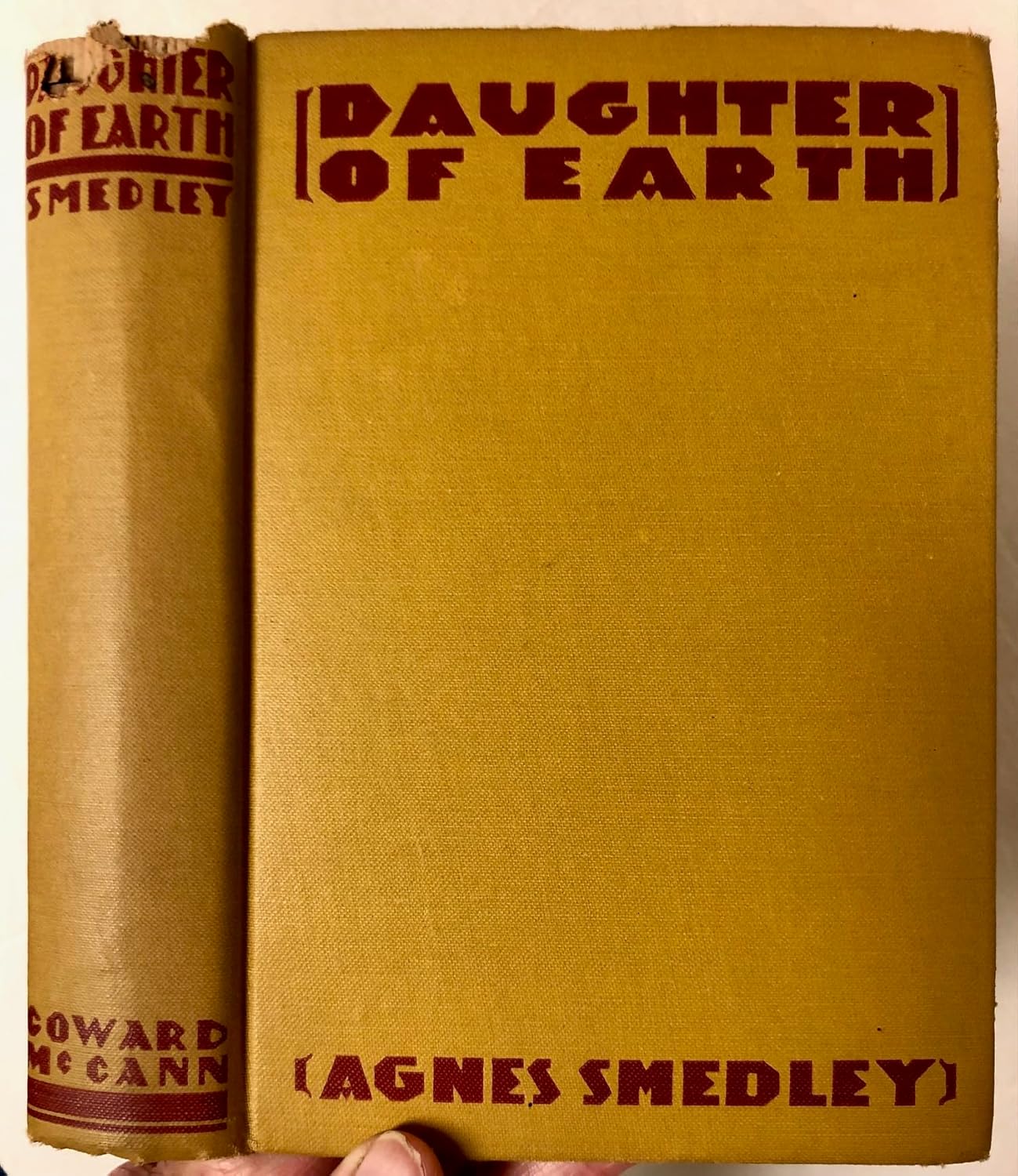
The Female John Reed

“Daughter of the Earth,” by Agnes Smedley, 1929

Agnes Smedley is a mostly forgotten left-wing American activist and writer.  She is best known for her reporting about the Chinese revolution.  Her second book, “Battle Hymn of China,” serves as a sequel to “Daughter of the Earth.”  Until the Nazi’s closed the paper, she reported for the Frankfurter Zeitung on the Chinese Red Army, and met Mao, Chou En Lai and Chu Te.  She then reported for other western publications, and wrote other books about the revolution there.  She is really the female John Reed of the Chinese revolution, and was later black-listed for this in the 1950s. 

Daughter of the Earth’ concerns itself with the American period before World War I until 1927.  It is a powerfully written semi-autobiographical novel of a working-class woman growing up in a brutal, poor and conservative society.  It is as plainly written as Maxim Gorky or Jack London might do, missing the similes or metaphors that litter more middle-class writing.  There are no ‘the sun rose like the headlight on an on-coming train’ in this book.  Her raw emotions and anger provide the fuel which carries you through most of the book.  She is an inchoate Emma Goldman, a political Calamity Jane, her own person. 

The fictional Marie Rogers was the daughter of poor farmers in Missouri.  Her father got sick of living that grueling life and convinced the family to move to the mining towns of Colorado.  There they encountered the world of the mining companies – company stores, militia, poverty, class arrogance, sickness, flooding and cold.  Later she moves, patterned after her father's wanderlust, alone to Arizona, New Mexico, San Francisco, then Kansas City, and ultimately New York City, leaving her drunk father, soon-to-be-dead mother, her mother’s sister, her two brothers and one sister behind. 

The most striking part of this book is how it describes a young woman trying to keep her dignity in a society that just sees her as a sexual target, a baby-maker or a weakling.  Marie has to fend off the advances of various drunks and those men drunk on their own personalities. She avoids sex like the plague because she knows it will lead to having a houseful of kids, beatings and misery.  She hates marriage because she wants no man telling her what to do.  She is forever being thought of as a prostitute or loose woman because she is not married.  The Christian religion is a foreign thing to her, and she knows it to be hostile to the poor.  She knows that only earning her own living will give her independence.  She dresses atrociously, from both poverty and choice.  She carries a small gun and knife and travels from town to town searching for knowledge – attending various schools, becoming a hardscrabble teacher, trying to find someone she trusts.  She meets the various leftists of the day – working-class IWW members, parlor Socialists, middle-class liberals and a few Communists, and has a natural class feel for all of them. 

Marie also feels the guilt of someone who wants to help her family, but basically abandons her siblings and relatives to pursue her life.  There is a lot of ‘I’ in Marie, which might have been her salvation.  Her emotions are always on the surface, she sees insults easily and deeply, she is not afraid to tell people what she thinks without sugar-coating it.  What she sees among the majority of working people is that they do not have a clue why the world is the way it is.  Food, drink, warmth, sex, money and music are sufficient balms and concerns.  Yet the miners strike time after time against the bloodthirsty mining concerns.  She slowly comes to a political consciousness through study, her contact with leftists and the very material roots of her miseries. 

Marie eventually moves to New York where she works for a book-reviewing publication, then “The Call” – a socialist newspaper, and also, oddly, for the Indian independence movement.  Through her work with the Indians, she is arrested and sent to the cold Tombs Prison – which she wryly notes is very close to Wall Street.  There she is starved, interrogated and incarcerated as a ‘spy.’  It is only with the end of World War I that she is released.  The socialists in New York can’t understand why she would work for nationalist Indians, but she (as Lenin would also have agreed) argues that freeing India from British rule advances the cause of world revolution.  Later she gets several high-profile scoops for the Call, including one where she accompanies an Irish Communist to an upstate prison pretending to be his girlfriend.  She eventually gets caught up in a jealousy triangle after finally marrying an Indian, and to avoid conflict within the Indian independence movement, leaves for Denmark.

This book follows on the heels of the earlier American working-class feminist classic, “Life in the Iron Mills.”  Novels by working-class people are rare, and ones that are political are rarer still.  This book is unique in its class and feminist stance.  It portrays a lonely and tough female personality that one rarely encounters, except, perhaps, in the pages of books.  It is our way of meeting Agnes Smedley herself, a real person.

And I bought it at May Day Books used/cutout book section.
Red Frog / February 23, 2013

Sunday, February 17, 2013

The Only Good South Vietnamese Farmer is a Dead South Vietnamese Farmer

“Kill Anything That Moves – the Real War in Vietnam,” by Nick Turse, 2013

This book recounts a tragedy so horrible, an experience so destructive, that a simple book review does not suffice. This is a book that shows the American War in Vietnam to be what it was – a high tech slaughter of millions of South Vietnamese civilians. For the generations of clueless Americans who vaguely know Vietnam was ‘bad’ – you don’t know how ‘bad.’  It will cure anyone of the Democratic or Republican parties.  It will cure anyone of praising the military machine.  It will cure anyone of simplistic thoughts about the innocence of good ‘ol U.S. boys.  It was free-fire, unadulterated mass murder, organized from the top.  The title of this book is not a ‘leftist’ generalization – it is a quote, a thought, a practice, repeated time and time again.

Body Count
Free-Fire Zones
Protected Hamlets – mass removal to squalid huts
Overkill; kill over and over
Kill prisoners – can’t take them along
War Criminals:  Westmoreland, McNamara, LBJ, Nixon, Kissinger, Singlaub, Laird, etc.
‘Scientific’ warfare methods
Industrial slaughter
Random murder
Orders from on High
Democrats and Republicans
Holocaust of Vietnamese

3 times more dead than the so-called ‘killing fields’ in Cambodia
Statistics:
58,000 dead Americans
304,000 wounded Americans
254,00 ARVN killed
783,000 wounded
1.7M Viet Cong / NLF dead
? VC / NLF wounded?
65,000 North Vietnamese civilians dead
2M South Vietnamese civilians dead – Harvard Medical School
7.3M Vietnamese casualties overall – Dead, KIA and wounded, Levy, Govt. of Vietnam
South Vietnam’s Population:  19M

Cluster bombs
White phosphorus
B-52 strikes
F-4 Phantoms
Napalm
Huey’s spitting bullets
Agent Orange defoliant
Friendly fire

South Vietnam is the most bombed place in history.
Orders
Destroy all buildings
Burn the ville
Fire the hooch
Level the rice, the fruit trees, the cane
Sink the sampan
Kill anything that moves, including the animals
Every bomb shelter hole in the ground is a VC bunker – grenades for all
Bomb craters in the paddies
Search & Destroy
Black pajamas are VC
Anyone who runs is VC
Little kids grow up to be VC
Water buffalo are VC
The “mere gook rule.”
Random shelling – use up your ammo
Ecocide
Pacification
The real Wasteland

Destroying the country to ‘save it’
They are not called Vietnamese, they are called ‘gooks’
Get the South Koreans to do it
Get the South Vietnamese Army to do it
CIA Operation Phoenix
Tiny 'Tiger' cages for humans; Tiger Force killers
Ewell:  Butcher of the Delta
A My Lai every week
What Geneva Convention?

Highway accidents; no speed limit
Leveled neighborhoods
Records of atrocities destroyed
West Point Protection Association
No one prosecuted
Cover-ups standard
Plant a Chi-Com grenade
Rape SOP
Torture normal – 93%
Trophy strings of ears around necks

War Pigs
The U.S. government and military - war criminals
Where is a Nuremburg when you need one?
Loser’s injustice wins.

(Other books about the Vietnam War, reviewed below:  "Into the Crossfire:  Adventures of a Vietnamese Revolutionary," and "Peoples' History of the Vietnam War.")
And I bought it at Mayday Books – and you should too.
Red Frog
February 17, 2013
The February Revolution in Russia has started, 1917

Tuesday, February 12, 2013

Aren't You Glad Capitalism Has Been Restored?

Latest Developments in Hungary

#1.  On November 27, Marton Gyongyosi, one of the fascist Jobbik's 44 lawmakers in the 386-seat Hungarian parliament, said during a debate on violence in the Gaza Strip that it would be "timely" to draw up a list of people of Jewish ancestry who posed a national security risk for their pro-Zionist views.  This illustrates that while some think defense of Palestine is an exclusively ‘left’ issue, ant-Semites use it to slander Jews. 

Gyongyosi was denounced even by Victor Orban, the rightist prime minister of Hungary, who prefers soft anti-Semitism, though it took him a week to do so. On December 2nd, 10,000 demonstrators converged on Budapest's Lajos Kossuth Square, next to the Parliament on the Danube, to protest Jobbik and anti-Semitism.  Jobbik has encountered little resistance from the government to its animosity toward the Roma (gypsy) minority and its efforts to rehabilitate unsavory figures such as Admiral Miklos Horthy, the country's pro-Nazi leader during World War II. 

The fascist Arrow Cross organized the deportation -- and subsequent murder -- of at least  430,000 Hungarian Jews in 1944.  The Nazi’s did not carry out the deportations, but relied on ethnic Hungarians.  Horthy was in power from 1919, when he took over after the destruction of the Hungarian Soviet Republic under Bela Kun by the Romanian Army.  He stayed in power until 1944, when he was deposed by the German Army for being insufficiently fascist, which put the Arrow Cross in power.  Kun himself was killed during one of Stalin’s purges in 1937, allegedly for being a ‘Trotskyite terrorist’ or some such fabrication. While Horthy was not instrumental, as far as I know, in the final roundup of Jews, his policies had been anti-Semitic for years, and laid the ground work for what happened.  He put Hungary in the Nazi camp, after all.  Horthy was a witness at Nuremberg, but was not indicted.

The Hungarian Communist Party eventually replaced this tradition of reactionary politics in the 1949 elections - elections which were never held again for the majority of people, in any form.  The Hungarian CP, which had been heavily Stalinist and repressive, eventually was schooled by the 1956 workers rebellion, and developed ‘goulash communism’ as a response.

#2. - Imre Kertesz, who wrote the great book “Fateless” about his experience in the concentrations camps as a 14 year old, has decided to move his archive to … Germany, not Hungary.  Yes, the organizer's of the camps.  He feels it will be more respected there.  This after a complete takeover of the art world in Budapest by Orban’s Party, which  is turning each venue into an exemplar of nationalist piety – the New Theatre, the Hungarian Academy of Arts and PEN.  Lawrence Ferlinghetti recently turned down a large cash award from the Hungarian PEN.  Elie Weisel has also returned a Hungarian award due to their laudatory reburial of a fascist writer.  Bela Tarr’s  premiere of “The Turin Horse” has been canceled by its Hungarian distributor.  And so it goes.    

#3. - At least someone is fighting back. December 19, 2012, thousands of high school and university students rallied in Budapest at the Academy of Sciences building, shutting down the Chain Bridge for a time.  They opposed education ‘reforms’ which would have severely cut 55,000 scholarships offered by the government.  The government later relented.   The students also opposed requirements that they be required to work in Hungary for several years after graduation if they accepted state funds. They also called for the resignation of the Education Secretary, so there are clearly a broad list of demands.  Orban’s intention was to put higher education in Hungary on a ‘self funding’ basis – an impossible goal unless all students are wealthy.  As if education is now a profit-making pursuit.  Student protests continue.

#4. – A third of the staff of one of the top universities in Budapest is being laid off.  The Orban government says they were appointed under ‘other administrations’ and therefore are illegitimate.  So much for freedom of research and freedom of thought.  A purge of the universities is under way.

#5. - Zsolt Bayer, a prominent conservative commentator, has sparked outrage in Hungary and abroad for comparing Roma to animals and saying they "shouldn't be allowed to exist." Criticism of the remarks has grown, but Prime Minister Orbán will probably keep silent.

Quote from Hungarian/English sources:  “Zsolt Bayer always pipes up whenever the Hungarian media mentions that Roma are suspected of involvement in a crime. Usually, he spares no words in his hate-filled tirades against the ethnic minority, regardless how ugly. For example, he has written: "Whoever runs over a Gypsy child is acting correctly if he gives no thought to stopping and steps hard on the accelerator." Bayer's most recent outburst came last Saturday after a bar fight and stabbing on New Year's Eve in which some of the attackers were reportedly Roma. Writing in the ultra-right-wing newspaper Magyar Hirlap, which has close ties to the conservative government, Bayer argued for what amounts to genocide.

Bayer wrote:
"A significant part of the Roma are unfit for coexistence. They are not fit to live among people. These Roma are animals, and they behave like animals. When they meet with resistance, they commit murder. They are incapable of human communication. Inarticulate sounds pour out of their bestial skulls. At the same time, these Gypsies understand how to exploit the 'achievements' of the idiotic Western world. But one must retaliate rather than tolerate. These animals shouldn't be allowed to exist. In no way. That needs to be solved -- immediately and regardless of the method."

Bring back Bela Kun, Gyorgy Lukacs, the Budapest Soviet and the workers' councils!

Red Frog / 
February 12, 2013

On Salutations and Signatures

Dear Fellow Commodity,

Throughout the years I have had numerous people inquire about the salutations and signatures I use in articles, e-mails and posts. Here is a brief explanation:

In 1974 I joined the New Union Party, a pro-worker, anti-capitalist group. I wrote a column for their paper The New Unionist which had the title NO NEED FOR SLAVES, NO ROOM FOR MASTERS. My salutation for the column (resurrected for my posts to this blog) was Dear Fellow Commodity which angered “individualists” who resented being called a commodity even though any thinking person would realize that workers are commodities;  they are bought and sold on the “labor market” just as slaves in the American south were bought and sold on the slave market.

I use the signature “AWAY WITH ALL BORDERS” on my email messages because I believe that citizens of the world should not be atomized by lines on a map drawn by world “leaders” in part for their personal glorification. (Capitalists have already done away with borders for the most part,) It's only workers who are still not internationally-minded and kill each other in wars that benefit the capitalists. A bayonet is a weapon with a worker on each end.

Saturday, February 9, 2013

He Used To Be A Radical

“The Conspiracy,” by Paul Nizan, 1938, forward by Jean Paul Sartre, 1960, afterward by Walter Benjamin

Paris is the brooding presence under every novel or film set in that city.  Its streets, history, river, monuments, neighborhoods and personalities soak the narrative.  For good reason.  Paris has been a center of philosophy, an archive of history, a birthplace of revolution.  ‘The Conspiracy’ is no different – it is set in Paris in the late 1920s, but the city plays a role in the shaping of its characters and the novel itself  This is a book written by former Communist Paul Nizan, who quit the Party upon hearing of the Molotov/Von Ribbentrop cooperation pact in 1939.  He wrote for L'Humanite, the Party newspaper.  He died at the Battle of Dunkirk in 1940.

Some Americans dislike Paris due to their own chauvinist or provincial upbringing or perhaps plain ignorance.  Yet Paris is a city of the world, not just of the French.  At one time in the ‘20s and ‘30s it was the center of world intellectual life in almost every discipline – writing, painting, dance, sculpture, music – even haute couture.  It gave rise to the phenomenon of the ‘bohemian,’ which morphed into the beats, which begat the hippies, and then the punks, grunge and now in its most pale commercial reflection, the ‘urban hipster.’  Black people like Josephine Baker and Cole Porter fled to Paris, as did Irish writers stifled by Catholicism.  American artistic expatriates started bookshops and wrote books; Spanish painters mixed with French surrealists.  One might say these events in Paris were one of the great renaissances of culture in the capitalist world, if not the greatest.  (see reviews of the importance of geographic ‘location’ in the formation of culture, in this case American music in “Laurel Canyon,” “Just Kids,” “In Search of the Blues” and The Grateful Dead, all below.)

It is 1928 and 1929.  The main characters of this book are the privileged sons of the local bourgeois – dissatisfied with a conventional life, unserious, yet committed to revolution.  Bernard Rosenthal is their leader – his father a stockbroker (yes, before 1929), his brother one too.   Of their families, though against them.  Nizan examines these inter-war youth and their desire to mean something.  Something other than a professional job, a boring wife, their fated elegant Parisian row-house on Rue Berlioz and their summer chateau in Picardy.  Why Nizan, a Party communist at the time, spends so much time on this sliver of the class is somewhat odd – unless it is part of a polemic against their influence on the revolutionary youth of the time. 

In order to encapsulate some of them, Nizan writes in the shade of Proust, and walks with him on the Channel beaches and into the country homes of romance and dull upper-class pleasures.  His portrayal of Rosenthal could be a disturbed 20-year-old student of that milieu.  They easily study for the Sorbonne and the Ecole Normale in the Quartier Latin and the Faubourg St. Germain.  Rosenthal, with 4 others - Pluvinage. Laforgue, Bloye and Jurien - start an overly-intellectual magazine for this rebellious generation.  Then, bored, he theorizes that ‘sabotage’ (a term that originated from the shoes of rebellious workers) is the real road to affecting change. The book sets you up to expect an early anarchist re-run of “The Invisible Committee.” (Reviewed below.)  Some plans for the defense of Paris and the location and structure of a large boiler in the city are stolen.  Instead, the ‘conspiracy’ Rosenthal really gets involved in is the seduction of his brother’s wife – his way of ‘overthrowing’ bourgeois morality and his family.  And the second conspiracy is that one of their number – Pluvinage, a son of a Parisian cemetery bureaucrat – turns informer on a ranking member of the Communist Party.  The Communist Party itself in 1929 was being accused of a an immediate ‘conspiracy’ to overthrow the French Government by force that fall, and hundreds were jailed.

The group had considered joining the Party to be in an intolerable affront to their independence, and hence had never joined.  Pluvinage, oddly, was the first to join, though he was the weakest in commitment.  

Nizan describes some scenes within a Party cell of working-class Parisians in the Belleville / Pere Lachaise area of the 20th Arrondissment.  He tracks the rich people on Avenue Mozart in de Passy.  Pluvinage, the informer, haunts the bars and prostitutes of Montmartre and Pigalle.  Pluvinage always felt socially inferior to Rosenthal and the rest, and eventually understands that the Communists would not come to power, and decides to stay with the ‘powerful’ on the Ile de la Cite and become a policeman – to do the ‘dirty work’ of Paris his own father did.  A third character, Laforgue, becomes very ill, and returns to the bosom of his bourgeois family.  Rosenthal himself commits suicide due to his grief at eventually losing the battle for his shallow paramour, his brother’s wife. 

An odd book, a snapshot of a faded time.  Well written, somewhat poetic, aimed at the untrustworthy petit-bourgeois youth who predictably give up on Left politics - then and in later ages.  And set in Paris, the city of much greater light.

And I bought it in the progressive literature section at May Day Books!
Red Frog / February 9, 2013